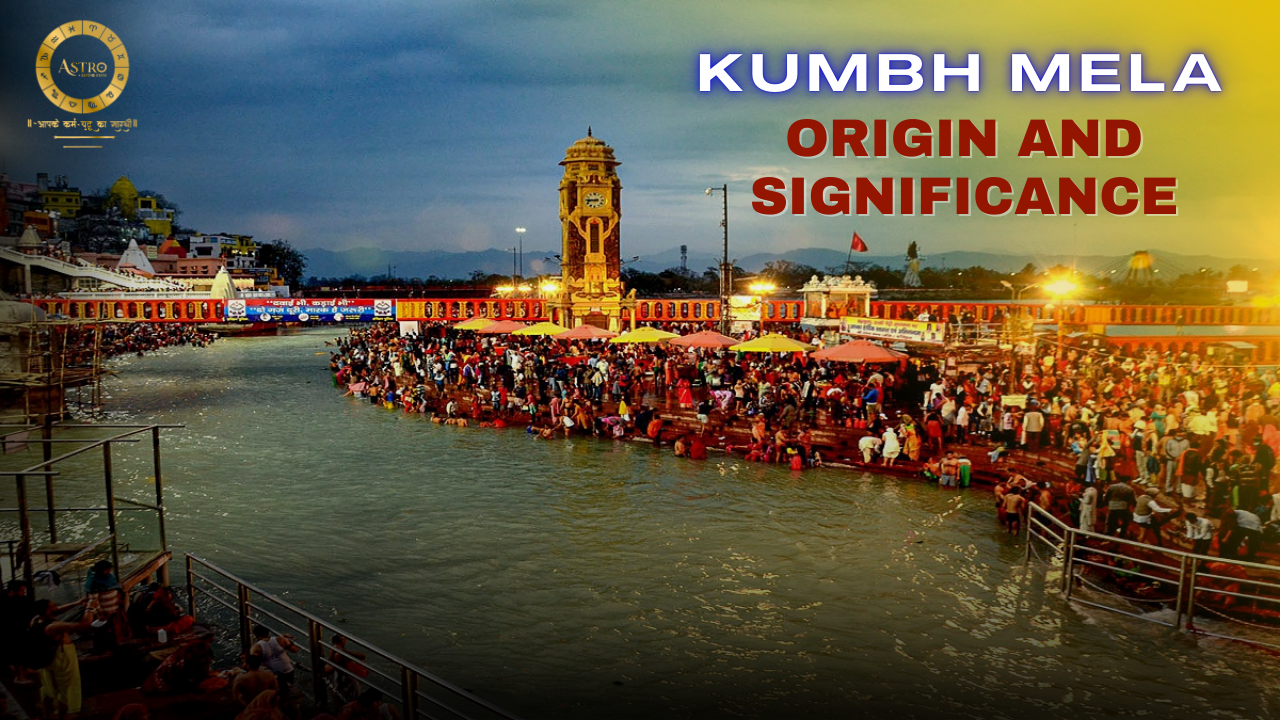
The Kumbh Mela is one of the largest religious gatherings in the world and a deeply significant event in Hinduism. It is a mass pilgrimage where millions of devotees, sadhus (holy men), saints, and seekers gather at specific sacred locations to bathe in holy rivers. The word “Kumbh” means pot (symbolizing the pot of nectar, or amrit) and “Mela” means fair or gathering.
Origins and Mythological Significance
The Kumbh Mela is rooted in Hindu mythology, particularly the story of the Samudra Manthan (churning of the ocean):
The gods (Devas) and demons (Asuras) churned the ocean of milk to extract Amrit, the nectar of immortality.As the pot of Amrit emerged, a fierce battle ensued between the gods and demons over its possession.During the struggle, drops of Amrit spilled at four locations: Haridwar, Prayagraj, Ujjain, and Nasik.
These locations became sacred, and it is believed that bathing in the rivers at these places during specific astrological alignments purifies sins and leads to moksha (liberation).
When and Where Is Kumbh Held?
The Kumbh Mela rotates among four locations in India:
Haridwar (on the Ganga River)
Prayagraj (confluence of Ganga, Yamuna, and Saraswati)
Ujjain (on the Shipra River)
Nasik (on the Godavari River)
The timing of Kumbh is determined by the astrological alignment of Jupiter, the Sun, and the Moon. There are four types of Kumbh Mela:
Maha Kumbh Mela (held every 144 years at Prayagraj)
Purna Kumbh Mela (held every 12 years at other locations)
Ardh Kumbh Mela (held every 6 years, only at Haridwar and Prayagraj)
Magh Mela (an annual smaller version, held at Prayagraj during the month of Magh).
Religious and Cultural Importance
Spiritual Purification: Bathing in the sacred rivers during the Kumbh is believed to wash away sins and free devotees from the cycle of birth and death.
Cultural Unity: The Kumbh Mela is a symbol of India’s cultural and religious diversity, bringing together people from all walks of life.
Knowledge Sharing: It is a confluence of spiritual discussions, debates, and discourses led by saints and scholars.
Pilgrimage of Faith: The act of traveling to the Kumbh demonstrates devotion and faith, making it a transformative spiritual journey.
Modern Significance
The Kumbh Mela is not only a spiritual event but also a showcase of India’s cultural heritage. It has been recognized by UNESCO as an Intangible Cultural Heritage of Humanity, highlighting its importance as a global spiritual and cultural phenomenon.
Calculations: The types of Kumbha are based on specific astrological calculations and the movements of celestial bodies. Here’s a more detailed explanation of each type and how astrologers determine the timing of the Mela The Kumbh Mela is held when Jupiter enters one of the Zodiac signs (Aries, Leo, or Sagittarius), and the Sun aligns with the Zodiac sign Capricorn (at the time of the winter solstice). The alignment of these planets creates a powerful cosmic moment, and taking dip in Ganga is auspicious to get blessings of 100 Ashwamedh Yajna.
The Ardh Kumbh is observed when Jupiter enters the Zodiac sign of Leo, and the Sun aligns with Capricorn, the same astrological alignment that occurs during the Kumbh Mela, but it takes place after a shorter interval of 6 years instead of 12. The Maha Kumbh Mela is celebrated when a particularly rare alignment of celestial bodies takes place, combining the positions of Jupiter, Sun, and Moon and Saturn. The most significant alignment occurs when Jupiter enters the zodiac sign of Aries, and both the Sun and Moon are in the same sign at the same time. This is seen as a unique cosmic event that only happens once in 144 years.
The positions of Jupiter and the Sun in the Zodiac are analyzed. Jupiter’s transit is particularly important since its movement through specific Zodiac signs (like Aries or Leo) is what triggers the timing of the Kumbh Mela.The phase and placement of the Moon also play a vital role. The full Moon and new Moon dates are carefully considered as these phases have a significant impact on the spiritual energy of the event.
Eclipses are another important consideration. A solar or lunar eclipse close to the event can influence the timing and significance, adding further depth to the spiritual relevance of the Kumbh.
The location of the Kumbh Mela—one of the largest religious gatherings in the world—is traditionally determined by the positioning of certain celestial bodies and their alignment, which corresponds to specific locations in India. These locations are pre-designated and rotate based on astrological calculations. There are four primary locations where the Kumbh Mela is held:
Haridwar (Uttarakhand) – On the banks of the Ganga River.
Prayagraj (Uttar Pradesh) – At the confluence of the Ganga, Yamuna, and the mythical Saraswati rivers.
Ujjain (Madhya Pradesh) – On the banks of the Shipra River.
Nasik (Maharashtra) – On the banks of the Godavari River.
Each of these locations is associated with a specific set of latitude and longitude coordinates:
Haridwar: 29.9457° N, 78.1642° E
Prayagraj: 25.4358° N, 81.8463° E
Ujjain: 23.1793° N, 75.7849° E
Nasik: 19.9975° N, 73.7898° E
The location and timing of the Kumbh Mela are determined by the position of Jupiter (Brihaspati), the Sun, and the Moon in specific zodiac signs. For example:
Haridwar: When Jupiter is in Aquarius and the Sun is in Aries.
Prayagraj: When Jupiter is in Taurus and the Sun and Moon align in Capricorn.
Ujjain: When Jupiter is in Leo and the Sun is in Aries.
Nasik: When Jupiter and the Sun are in Leo.
The alignment of these celestial bodies dictates the exact location and dates of the Kumbh Mela in a 12-year cycle.
The locations of the Kumbh Mela hold deep spiritual, mythological, and cultural significance in Hinduism. These four locations, i.e. Haridwar, Prayagraj, Ujjain, and Nasik, are tied to ancient traditions, celestial alignments, and sacred rivers, which are considered purifying and spiritually uplifting. Here’s the importance of each:
The significance of the Kumbh Mela locations of Haridwar, Prayagraj, Ujjain, and Nasik, stems from their deep spiritual, mythological, and religious associations. Each location is tied to sacred rivers and celestial alignments, symbolizing purification, spiritual renewal, and liberation (moksha). Here’s the significance of each location:
1. Haridwar (Uttarakhand)
River: Ganga
Haridwar, meaning “Gateway to the Gods,” is where the Ganga River enters the plains from the Himalayas, making it a highly sacred site for purification and spiritual upliftment.
Mythologically, Haridwar is one of the four places where drops of the nectar of immortality (Amrit) spilled during the celestial battle between gods and demons (as per the Samudra Manthan or churning of the ocean myth).
Bathing in the Ganga here is believed to cleanse sins and lead to moksha (liberation).
2. Prayagraj (Uttar Pradesh)
Rivers: Confluence of Ganga, Yamuna, and Saraswati
Known as Triveni Sangam, Prayagraj is the confluence of three sacred rivers: Ganga, Yamuna, and the mythical Saraswati. This confluence is considered a powerful spiritual site.
Prayagraj is said to represent a balance of physical, mental, and spiritual energies. Bathing here is believed to bring spiritual purification and liberation from the cycle of birth and death.
It is also associated with the Vedas and ancient rishis (sages), making it a central place of Hindu tradition and culture.
3. Ujjain (Madhya Pradesh)
River: Shipra
Ujjain is home to the Mahakaleshwar Jyotirlinga, one of the twelve sacred shrines of Lord Shiva, making it a center of Shaivism.
The Shipra River is considered a sacred river that purifies and blesses devotees.
Ujjain’s association with Lord Shiva and the story of the spilling of Amrit give it a strong spiritual foundation.
According to Hindu astrology, Ujjain is linked to the precise astronomical alignment of Jupiter in Leo (Simha Rashi) and the Sun, which amplifies its cosmic and spiritual energy.
4. Nasik (Maharashtra)
River: Godavari
The Godavari River, often referred to as the Ganga of the South, is considered highly sacred.
Nasik is associated with the Ramayana, as it is believed to be the location where Lord Rama, Sita, and Lakshman spent part of their exile.
The mythological association with the Amrit spill during the Samudra Manthan further adds to its significance.
Bathing in the Godavari during the Kumbh Mela is believed to bring spiritual merit and free devotees from past karma.
Common Significance of All Locations
Celestial Alignment: Each location is chosen based on specific astrological alignments of Jupiter, the Sun, and the Moon, believed to create powerful spiritual energy.
Mythology: The legend of the Samudra Manthan and the spilling of Amrit connect all four locations, making them focal points for spiritual gatherings.
Purification and Moksha: Bathing in the rivers at these sites during Kumbh Mela is considered a way to cleanse sins, dissolve bad karma, and attain liberation.
These locations collectively form a spiritual circuit where devotees can experience a deep connection with the divine, the cosmos, and ancient traditions.
The Kumbh Mela is one of the largest religious gatherings in the world and a deeply significant event in Hinduism. It is a mass pilgrimage where millions of devotees, sadhus (holy men), saints, and seekers gather at specific sacred locations to bathe in holy rivers. The word “Kumbh” means pot (symbolizing the pot of nectar, or amrit) and “Mela” means fair or gathering.
Origins and Mythological Significance
The Kumbh Mela is rooted in Hindu mythology, particularly the story of the Samudra Manthan (churning of the ocean):
The gods (Devas) and demons (Asuras) churned the ocean of milk to extract Amrit, the nectar of immortality.As the pot of Amrit emerged, a fierce battle ensued between the gods and demons over its possession.During the struggle, drops of Amrit spilled at four locations: Haridwar, Prayagraj, Ujjain, and Nasik.
These locations became sacred, and it is believed that bathing in the rivers at these places during specific astrological alignments purifies sins and leads to moksha (liberation).
When and Where Is Kumbh Held?
The Kumbh Mela rotates among four locations in India:
Haridwar (on the Ganga River)
Prayagraj (confluence of Ganga, Yamuna, and Saraswati)
Ujjain (on the Shipra River)
Nasik (on the Godavari River)
The timing of Kumbh is determined by the astrological alignment of Jupiter, the Sun, and the Moon. There are four types of Kumbh Mela:
Maha Kumbh Mela (held every 144 years at Prayagraj)
Purna Kumbh Mela (held every 12 years at other locations)
Ardh Kumbh Mela (held every 6 years, only at Haridwar and Prayagraj)
Magh Mela (an annual smaller version, held at Prayagraj during the month of Magh).
Religious and Cultural Importance
Spiritual Purification: Bathing in the sacred rivers during the Kumbh is believed to wash away sins and free devotees from the cycle of birth and death.
Cultural Unity: The Kumbh Mela is a symbol of India’s cultural and religious diversity, bringing together people from all walks of life.
Knowledge Sharing: It is a confluence of spiritual discussions, debates, and discourses led by saints and scholars.
Pilgrimage of Faith: The act of traveling to the Kumbh demonstrates devotion and faith, making it a transformative spiritual journey.
Modern Significance
The Kumbh Mela is not only a spiritual event but also a showcase of India’s cultural heritage. It has been recognized by UNESCO as an Intangible Cultural Heritage of Humanity, highlighting its importance as a global spiritual and cultural phenomenon.
Calculations: The types of Kumbha are based on specific astrological calculations and the movements of celestial bodies. Here’s a more detailed explanation of each type and how astrologers determine the timing of the Mela The Kumbh Mela is held when Jupiter enters one of the Zodiac signs (Aries, Leo, or Sagittarius), and the Sun aligns with the Zodiac sign Capricorn (at the time of the winter solstice). The alignment of these planets creates a powerful cosmic moment, and taking dip in Ganga is auspicious to get blessings of 100 Ashwamedh Yajna.
The Ardh Kumbh is observed when Jupiter enters the Zodiac sign of Leo, and the Sun aligns with Capricorn, the same astrological alignment that occurs during the Kumbh Mela, but it takes place after a shorter interval of 6 years instead of 12. The Maha Kumbh Mela is celebrated when a particularly rare alignment of celestial bodies takes place, combining the positions of Jupiter, Sun, and Moon and Saturn. The most significant alignment occurs when Jupiter enters the zodiac sign of Aries, and both the Sun and Moon are in the same sign at the same time. This is seen as a unique cosmic event that only happens once in 144 years.
The positions of Jupiter and the Sun in the Zodiac are analyzed. Jupiter’s transit is particularly important since its movement through specific Zodiac signs (like Aries or Leo) is what triggers the timing of the Kumbh Mela.The phase and placement of the Moon also play a vital role. The full Moon and new Moon dates are carefully considered as these phases have a significant impact on the spiritual energy of the event.
Eclipses are another important consideration. A solar or lunar eclipse close to the event can influence the timing and significance, adding further depth to the spiritual relevance of the Kumbh.
The location of the Kumbh Mela—one of the largest religious gatherings in the world—is traditionally determined by the positioning of certain celestial bodies and their alignment, which corresponds to specific locations in India. These locations are pre-designated and rotate based on astrological calculations. There are four primary locations where the Kumbh Mela is held:
Haridwar (Uttarakhand) – On the banks of the Ganga River.
Prayagraj (Uttar Pradesh) – At the confluence of the Ganga, Yamuna, and the mythical Saraswati rivers.
Ujjain (Madhya Pradesh) – On the banks of the Shipra River.
Nasik (Maharashtra) – On the banks of the Godavari River.
Each of these locations is associated with a specific set of latitude and longitude coordinates:
Haridwar: 29.9457° N, 78.1642° E
Prayagraj: 25.4358° N, 81.8463° E
Ujjain: 23.1793° N, 75.7849° E
Nasik: 19.9975° N, 73.7898° E
The location and timing of the Kumbh Mela are determined by the position of Jupiter (Brihaspati), the Sun, and the Moon in specific zodiac signs. For example:
Haridwar: When Jupiter is in Aquarius and the Sun is in Aries.
Prayagraj: When Jupiter is in Taurus and the Sun and Moon align in Capricorn.
Ujjain: When Jupiter is in Leo and the Sun is in Aries.
Nasik: When Jupiter and the Sun are in Leo.
The alignment of these celestial bodies dictates the exact location and dates of the Kumbh Mela in a 12-year cycle.
The locations of the Kumbh Mela hold deep spiritual, mythological, and cultural significance in Hinduism. These four locations, i.e. Haridwar, Prayagraj, Ujjain, and Nasik, are tied to ancient traditions, celestial alignments, and sacred rivers, which are considered purifying and spiritually uplifting. Here’s the importance of each:
The significance of the Kumbh Mela locations of Haridwar, Prayagraj, Ujjain, and Nasik, stems from their deep spiritual, mythological, and religious associations. Each location is tied to sacred rivers and celestial alignments, symbolizing purification, spiritual renewal, and liberation (moksha). Here’s the significance of each location:
1. Haridwar (Uttarakhand)
River: Ganga
Haridwar, meaning “Gateway to the Gods,” is where the Ganga River enters the plains from the Himalayas, making it a highly sacred site for purification and spiritual upliftment.
Mythologically, Haridwar is one of the four places where drops of the nectar of immortality (Amrit) spilled during the celestial battle between gods and demons (as per the Samudra Manthan or churning of the ocean myth).
Bathing in the Ganga here is believed to cleanse sins and lead to moksha (liberation).
2. Prayagraj (Uttar Pradesh)
Rivers: Confluence of Ganga, Yamuna, and Saraswati
Known as Triveni Sangam, Prayagraj is the confluence of three sacred rivers: Ganga, Yamuna, and the mythical Saraswati. This confluence is considered a powerful spiritual site.
Prayagraj is said to represent a balance of physical, mental, and spiritual energies. Bathing here is believed to bring spiritual purification and liberation from the cycle of birth and death.
It is also associated with the Vedas and ancient rishis (sages), making it a central place of Hindu tradition and culture.
3. Ujjain (Madhya Pradesh)
River: Shipra
Ujjain is home to the Mahakaleshwar Jyotirlinga, one of the twelve sacred shrines of Lord Shiva, making it a center of Shaivism.
The Shipra River is considered a sacred river that purifies and blesses devotees.
Ujjain’s association with Lord Shiva and the story of the spilling of Amrit give it a strong spiritual foundation.
According to Hindu astrology, Ujjain is linked to the precise astronomical alignment of Jupiter in Leo (Simha Rashi) and the Sun, which amplifies its cosmic and spiritual energy.
4. Nasik (Maharashtra)
River: Godavari
The Godavari River, often referred to as the Ganga of the South, is considered highly sacred.
Nasik is associated with the Ramayana, as it is believed to be the location where Lord Rama, Sita, and Lakshman spent part of their exile.
The mythological association with the Amrit spill during the Samudra Manthan further adds to its significance.
Bathing in the Godavari during the Kumbh Mela is believed to bring spiritual merit and free devotees from past karma.
Common Significance of All Locations
Celestial Alignment: Each location is chosen based on specific astrological alignments of Jupiter, the Sun, and the Moon, believed to create powerful spiritual energy.
Mythology: The legend of the Samudra Manthan and the spilling of Amrit connect all four locations, making them focal points for spiritual gatherings.
Purification and Moksha: Bathing in the rivers at these sites during Kumbh Mela is considered a way to cleanse sins, dissolve bad karma, and attain liberation.
These locations collectively form a spiritual circuit where devotees can experience a deep connection with the divine, the cosmos, and ancient traditions.